
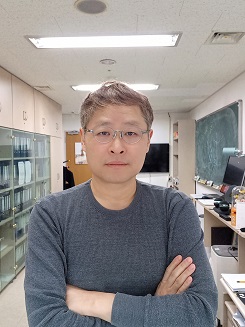
Joon Ik Jang
Professor of Physics
Office : R1027
http://www.researchgate.net/profile/Joon_Jang3
https://scholar.google.com/citations?user=cB4_h4AAAAAJ&hl=en&oi=ao
Email : jjcoupling@sogang.ac.kr
Academic history
2005: University of Illinois, Urbana, USA, Ph.D. in Physics
Thesis: Lifetimes of excitons in cuprous oxide (Advisor: Prof. J. P. Wolfe)
1994: Yonsei University, Seoul, Republic of Korea, B.S. in Physics
Professional Career
2023~Present: Professor, Physics Department, Sogang University, Seoul, Republic of Korea
2018~2022: Associate Professor, Physics Department, Sogang University, Seoul, Republic of Korea
2010~2017: Assistant Professor, Physics Department, State University of New York (SUNY), Binghamton, NY USA
2008~2010: IGERT Postdoctoral Scholar, Physics Department, Northwestern University, Evanston, IL USA
2005~2008: Postdoctoral Fellow, Physics Department, Northwestern University, Evanston, IL USA
He was drawn to study the electronic and optical properties of various semiconducting materials by the surprisingly rich diversity of interesting physical phenomena and novel applications observed from novel materials, including low-dimensional quantum structures. His current research interest encompasses several important topics related to light-matter interactions in emerging systems such as organic-inorganic halide perovskites, atomically thin transition metal dichalcogenides (TMDs), nonlinear optical materials, etc. In particular he has extensive expertise in studies of these novel materials and structures where he contributed to many exciting recent discoveries obtained utilizing his own experimental technique, wavelength-dependent Z-scan nonlinear spectroscopy (WDZNS).
His research philosophy is founded on the following four interwined goals: 1) earn recognition as an independent, leading scientist in condensed matter physics and materials science; 2) establish and sustain an active group that performs cutting-edge multidisciplinary research with a considerable impact on fundamental science as well as technological applications; 3) lead synergistic collaborative research that builds strong ties with other groups on a global scale; and 4) continue mentoring students and postdoctral researchers to prepare them as future leaders in academia and industry.